How Online Home Values Are Calculated (And Why They’re Often Wrong)
Online home value estimates can be misleading. Learn how automated home valuations work, what they miss, and why a local expert provides a more accurate price.
Scott Champion and Real Estate Company.
12/15/20252 min read

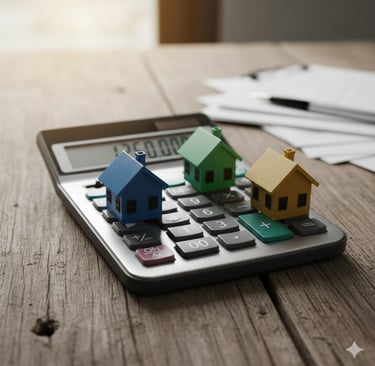
If you’ve ever searched your home online, chances are you’ve seen an estimated value pop up instantly. These numbers feel official, data-driven, and precise — but in reality, online home value estimates are often incomplete and sometimes flat-out wrong.
Let’s break down how these values are calculated, why they miss the mark, and what homeowners should use instead.
How Online Home Values Are Calculated
Online home values are generated by automated valuation models (AVMs). These are algorithms that analyze large amounts of public and historical data to estimate a property’s value.
Most AVMs rely on:
Recent sales of nearby homes
Public tax records
Property size and lot dimensions
Number of bedrooms and bathrooms
Market trends and averages
Using this data, the algorithm compares your home to others and applies mathematical formulas to predict a value.
👉 What’s important to understand:
These systems work well for general trends, not for specific homes.
What Online Valuations Don’t See
This is where the problem begins.
AVMs cannot accurately account for:
Interior condition and renovations
Quality of finishes and upgrades
Floor plan functionality
Lot positioning (corner lot, slope, privacy)
Street-by-street or block-by-block differences
Recent repairs or deferred maintenance
Unique features that don’t fit a formula
Two homes may look identical on paper but sell for very different prices in real life. Algorithms can’t walk through your home — people can.
Why Online Home Values Are Often Wrong
1. They Lag Behind the Market
Online estimates update based on recorded sales, not real-time activity. In fast-moving markets, this creates delays and inaccuracies.
2. They Over-generalize Neighborhoods
Algorithms often group homes too broadly, ignoring micro-market differences that local professionals know instantly.
3. They Don’t Adjust for Condition
A fully renovated home and a fixer-upper may receive similar estimates if the data looks the same on paper.
4. They Create False Confidence
Buyers may overpay or sellers may overprice because they trust a number without context.
When Online Home Values Can Be Useful
Online estimates aren’t useless — they’re just limited.
They can help with:
Getting a very rough price range
Understanding market direction
Comparing general neighborhood trends
They should never be the final word when buying or selling.
What Provides a More Accurate Home Value?
The most accurate home pricing comes from a local, professional evaluation, which includes:
In-person or detailed visual assessment
Knowledge of recent off-market activity
Understanding buyer demand in your area
Adjustments for condition, upgrades, and uniqueness
A local expert combines data + human judgment, which no algorithm can replicate.
The Bottom Line
Online home values are a starting point — not a decision tool.
If you’re planning to sell, buy, refinance, or invest, relying solely on an automated estimate can cost you thousands. Real value comes from context, condition, and local expertise, not just code.
📌 Final Takeaway
A home’s true value isn’t found in an algorithm — it’s found in understanding the property, the market, and the buyer.
Quick Links
Company
Properties
Your trusted partner in real. Making dreams come true,
one home at a time.
2835 Zelda Rd Suite 13, Montgomery, AL 36106, United States
customerservice@scottchampionrealestate.com
Phone: +1 334-324-1139
Hours: Mon-Fri: 9AM–5PM, Sat-Sun: Closed
Social Media
© 2025 Scott Champion & Company. All rights reserved.